.

.

Friday, October 04, 2013

IPB, Collarette Structure, Pupillary Zone & Peripheral Signs - Rx - (gane)


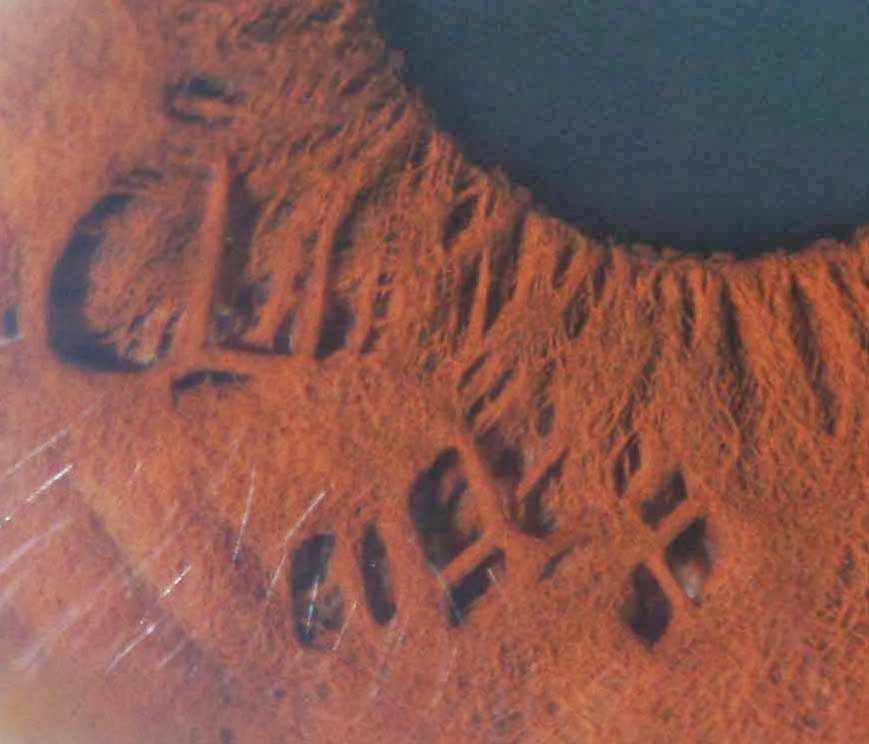
Observe the inner pupillary border tissues, collarette structure, breaks or converge contraction furrows and corneal arcus covered at ventral section of ciliary to limbus zone. 
a) Identify the hypertrophy of the IPB at superior nasal section - 30' to 60' . This introflession of the IPB leading to what genetic weakness to this person ?
b) Can you identify what type of morphology attached to this IPB ? 
c) Crypts at pupillary zone - 140', 247' & 285', consider analyse these in embryological & cellular levels. Can you seen Stairstep lacuna at 140' ?
d) Multiple contraction furrows breaks in this topographical areas, what does it means ?
e) Corneal Arcus concentrated at ventral section of iris limbus, what indication for this genetic formation ? We called this genetic sign as "Ventral Arcus".
f) Could you explain what genetic weakness for constricted collarette in physical & psycho-emotional levels plus this person is inherited by paternal or maternal DNA predominant ?

Thursday, October 03, 2013

Space Risk Evaluation - Lx - (tbs)


Could you identify and determine a Space Risk under this partial atrophy IPB structure ?


Female, 42
a) The local absence of the IPB 53', 60'-70'  & 302' the gap distance is between 5' to 10' degree, what does it represent for space dimension deficiency or Space Risk ?
b) Space dimension at 302' 53' and embryological sign - internal lacuna at 90'  they are correlate to indicate a personal and family genetic tendency to endocrine system imbalance. Could you identify what type of gland is genetically affected  by this person ?

Multi-Bridged Collarette - Lx - (psp)


Multi-bridged collarette indicates a tendency to progesterone deficiency.

Tuesday, October 01, 2013

Thyroid Dysfunction Sign - Rx - (gse)


Female,52
This person is affected by thyroid gland dysfunction about the aged of 42. Could you find an iris sign that is genetically relate to this problem ? You may try to look for this thyroid sign beyond the classical approach.The patient does not tell me about her thyroid problem in the first place, and she even forgot this problem as she was recovered few years ago. In practice, this inheritance weakness indicating to personal, family medical history and can be traced up to 4 generations. So, I recommend to check her children and siblings irises as well..
Suggestions on how to identify an important iris sign via applying Multidimensional Iridology as follow:
1) First thing First ! Analyse the diameter of IPB structure it will give you an overall genetic characteristics about this person, because it represent more accurate tendencies than traditional Iris Constitution Types by Structure, Dispositions & Diathesis.
The diameter of IPB can be classified as:
- Normotrophic
- Hypertrophy
- Hypotrophy
- Atrophy
- Partial Atrophy
- Mixed Border
2) The 2nd steps to identify and analyse it morphologies, a different shapes of IPB represent an accurate genetic information to a practitioner, they indicate a profound guides for physical pathologies and psycho-emotional traits.
3) The structure of IPB also represents a space dimension deficiency, it indicate a pathology, genetic inheritance history and psycho-emotional issues for that individual, according to the type of change in the structure of the IPB and it location. It also indicating the spinal vertebrae deficiency or neuro-muscular tension on 26 "spaces" of spinal cord. 
The Space Risk can be identified in local "mechanism" as:
- Introflession
- Extroflession
- Hypertrophy   
- Absence
- Pigmentation adjacent to the IPB
You have to equip with high magnification via iris microscope and correct illumination lamps and digital camera with at least 10 mega pixels.
4) The 3rd steps to identify an important iris sign in embryological & cellular levels via observing sign at pupillary zone and internal collarette border.
5) The 4th look for small, tiny and solitary iris sign attached on the external border of the collarette, as it reflect endocrine system imbalance.
6) Conglomerate all your findings then look for "combination" & "correlation" signs that it can enhance the accuracy and amplify the meanings of the findings !


Local absent of the IPB at 302' signify Space Risk 7 indicate personal predisposition and family genetic history of thyroid gland dysfunction and potential of neuromuscular tension at Thoracic Vertebrae - T12.

Monday, September 30, 2013

Space Dimension Deficiency - Local Absent of IPB - Lx - (psp)


How to identify a space deficiency or space risk under this partial atrophy inner pupillary border structure ?

Space Risk is measured in various range of 5', 8', or 10' and above degree along with inner pupillary border tissues. A sectional absence of inner pupillary border tissues, where the gap or space dimension is more than 10' and local absent is within 10', both condition can be counted as Space Risk. We have to make sure that a local or sectional IPB, the micron or diameter must be in zero degree so as to fulfill the Space Risk requirement. We will explore more about Space Risk in term of local or sectional introflession, extroflession of IPB.

Inner Pupillary Border - Standard Approach for Modern Iridologist - Lx - (osh)


Please identify and interpret the multiple local absence of the IPB correlates with Space Risk & IPB Spinal evaluation and the highlighted lacunae attached on the border of the collarette.

Inner Pupillary Border - Standard Approach for Modern Iridologist - Rx- (osh)


Male,57
There is a common practice for practitioner to observe and analyse lacunae & crypts attached on the  border of the collarette & ciliary zone. We should set priority to analyse an IPB structure and its morphologies, as it represents of our physical, psychological, genetic, chromosomes, space dimension, hereditary and space vertebrae or neuromuscular tension in our spinal cord. I hope this will become a standard and basic requirement for you as a modern Iridologist to practice. Obviously, a next step will be in embryological level at pupillary zone then to endocrine topographical areas of external border of the collarette. There is no much iris sign can be found in outer ciliary or peripheral iris zone, accept contraction furrow in Brown iris and ciliary transversal in Lymphatic & Mixed iris constitution. This will become a norm and I suggest a practitioner be ready for this trend, especially for those who had equipped with the Professional Iris Camera with Microscope. 


Could you identify and analyse these three local IPB structure ? What type of genetic weakness carried by them ?
a) Local absent of the IPB at 40' signify as Space Risk 5 & crypt at ciliary zone - 94', if we integrate both signs, what does it means to that individual, and which section areas of spinal cord is affected ? 
b) This is a globular IPB sign, if combine with the crypt located at pupillary zone - 218', again, what does it enhance to the genetic sign ?
c) I would suggest this extended inner pupillary border to pupillary zone as a local extroflession of the IPB, represent a space change and leading to a genetic deficiency of Space Risk 12. The Corneal Arcus is enhance the lipids levels of this space deficiency.


Crypts and small lacunae that attached to the external border of the collarette should be highlighted and analysed compared to normal shaped of lacunae. Small lacunae at 150' & 160', crypts at 230' & 218' at pupillary zone, they are set for priority to analyse. What about the lacuna at 185'  ? Shall we count on it ?If the crypts are combined with our findings at IPB shapes & structure then it can amplify the meaning of the identified genetic weakness and it relates to paternal DNA predominant ! Why ? Please define this collarette structure !

Partial Atrophy of IPB - Lx - (lsh)


To identify the IPB structure & its morphologies, must be priority for a modern & advanced practitioner to practice. IPB indicates physical, psycho-emotional, hereditary, chromosomes & spinal vertebrae for a person.


Omega IPB, is a unique and solitary IPB sign located along the frontal inner pupillary border. It represents with overactivity of the immune system. It indicates the possibilities of:
- Current acute tonsillitis
- Personal predisposition & family medical history of tonsillitis
- Genetic tendency to Rheumatoid Arthritis
Please also take note that the major rays / radial furrows of 10' & 12' at topography of paranasal sinus areas and a local indentation of the collarette toward to embryological pupillary zone of tonsils area at Rx-iris.

IPB, Pupillary Zone & Collarette - In Multidimensional Iridology Views - Rx - (lsc)


Female, 71
Observe this IPB structure, pupil flattenings, signs at pupillary zone, internal & external border of the collarette and it collarette structure. Please try... 

Sunday, September 29, 2013

Local Introflession at the Partial Atrophy of the IPB at - Lx - (lbp)


Could you identify a local inner pupillary border tissue is in a form of introflession of IPB ? What does it space dimension deficiency means to a practitioner in term of  physiological, emotional, hereditary & spinal vertebrae ?

A local indented absent of the IPB at 275', this indicate a space deficiency of inner pupillary border and it signify Space Risk 12, which represent predisposition to liver deficiency. This space dimension deficiency amplified by formation of Cornea Arcus at limbus zone 

Collarette Structure in Modern Iridological Approach - Lx - (lbp)


Observe this lateral temporal section of the collarette structure, what does it means to a practitioner ? What genetic information can we retrieve from this collarette structure ? Please try... 


Hypertrophy, linear, raised and multibridged formation along the external border of the collarette structure, it indicates a tendency to progesterone deficiency and predisposition to blood sugar imbalance. In addition, take & measure the mid-point of the bridge as Time Risk sign ! From this sample, we can take the bridge with an even internal or external arc as Time Risk- 1 & 2 to measure the traumatic time/events ! I suggest the Emotional Dynamics of the Collarette can also be take into account !

Saturday, September 28, 2013

IPB, Pupil, Pupillary Zone, Internal & External Border of the Collarette - Multidimensional Views - Lx - (Azlee)

Please analyse this Lx-iris , the sequence of this iris assessment as follow:


Obviously, the above inner pupillary border tissues some are absent or missing in local areas, protrude out to pupillary zone and other extend internally to the pupillary margin of iris. In Space Risk, it means:
a) & b) Local absent of the IPB at 150' & 250' signify Space Risk 23 & 16, they are indicate prostate & adrenal insufficiency tendency. Refer to Rx-iris analysed results, the prostate & adrenal imbalance enhanced by Citrate acid imbalance ( closed lacuna at pupillary zone - 60').
c) Extroflession of the IPB at 305' signify Space Risk 7 indicate predisposition to thyroid gland dysfunction, again it was enhanced by Squared IPB at Rx-iris !
d) Introflession of the IPB at 322' signify Space Risk 5 indicate potential of tonsillitis, pharyngitis & laryngitis problems.


Lateral Temporal Flatness indicates predisposition to circulatory problems, asthma and emotional heart problems. Take note the Space risk 5 at Lx-iris and heart lacuna -270' , Space Risk 1 and frontal pupil flatness at Rx-iris.


The hypothalamus stress as radial furrow at 0' or 360' is set priority to analyse, as it enhance the meaning of overall genetic weaknesses found in this iris. Please try to interpret the identified iris signs at pupillary zone, the collarette structure, endocrine signs attached at the border of the collarette plus compare it with Rx-iris ! I hope these two case studies - Rx & Lx will instigate you to study and learn the advanced & modern iridological approaches so as to enhance, sharpen & broaden your iris analysis skills & techniques there is applying Multidimensional Iridology. You may pay less attention where a sign located at limbus zone, e.g Contraction Furrow are peripheral signs, it contribute mild level of genetic effect to an individual, they are consider normal, genetic origin, natural drainage channels for excess fluid within the structure of the frontal eye. Nevertheless, we have pay attention to where they break or terminate will be the focus for stress. Draw you attention much on the IPB structures, Pupil Dynamics, Pupillary Zone, Internal & External Border of the Collarette. Look for iris sign in unique, small, solitary, combination and correlation sign within and both irises in embryological, epigenetic and cellular levels.

Wednesday, September 25, 2013

Medical Camp at Cathedral of Holy Spirit Church