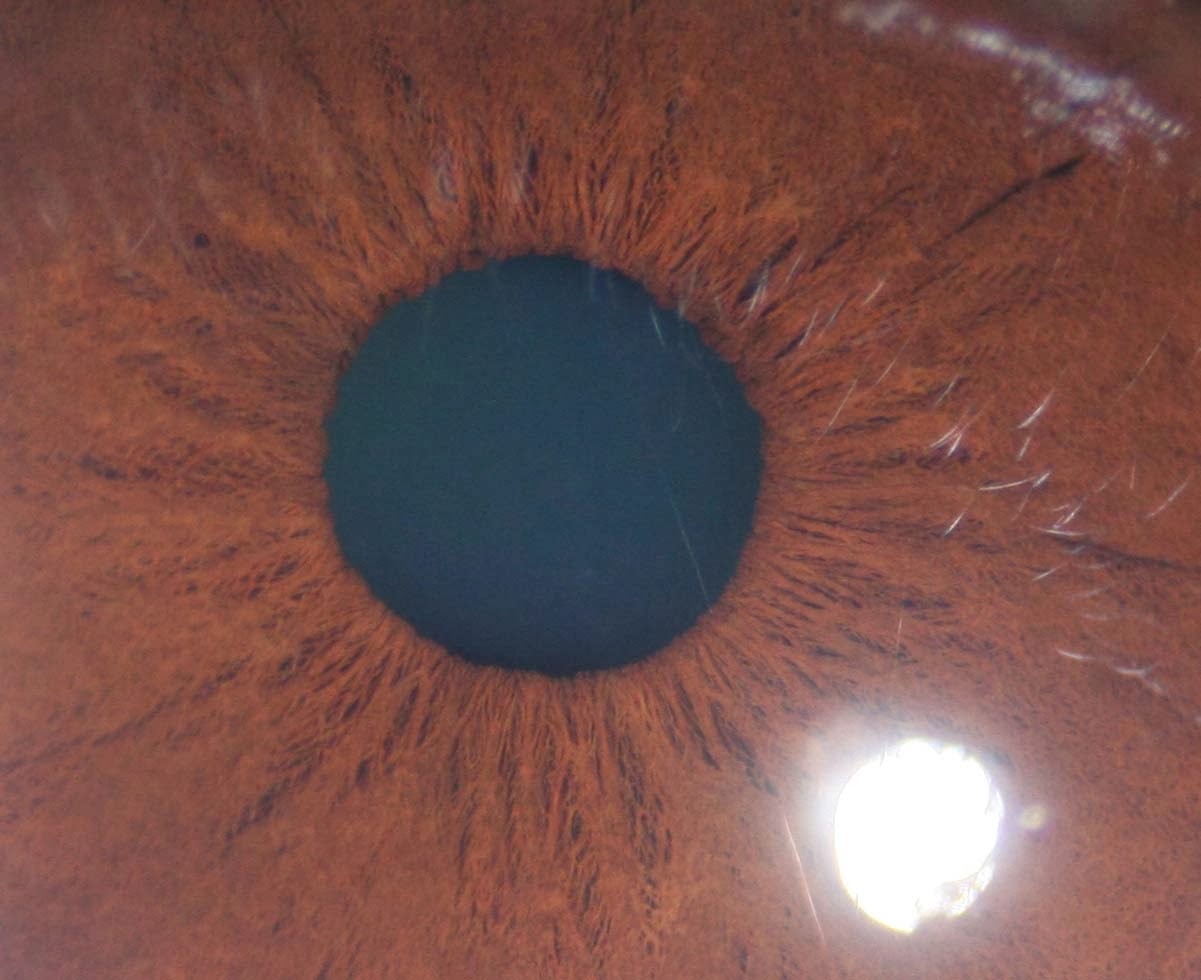
Answer: These four iris signs are correlation with adrenal imbalance !
.
Wednesday, January 15, 2014
Atrophy IPB, Inferior Nasal Pupil Flatness & Embryological Signs - Lx - (menna)
Answer: These four iris signs are correlation with adrenal imbalance !
The Atrophy IPB - Rx - (menna)
Explain the general genetic weaknesses for atrophy IPB structures. This type of IPB structure predominantly indicate a tendency of premature ageing due to oxidative stress.
Monday, January 13, 2014
Finding of Correlation Iris Signs in Multidimensional Iridology Approaches - Rx - (mania)
Male,60
a) Explain the frontal & lateral temporal pupil flatness in physical & emotional levels.
b) Observe the important genetic sign of beak lacuna at 205' and why it correlation with lateral temporal flatness ?
c) Explain the correlation iris signs of ventral linear collarette, Krebs Cycle sign (crypt) at 200-x and external border of the collarette - 130' & 135'.
d) Explain the genetic condition of lacuna attached at the external collarette border - 175' that the contraction furrows intercepted with rarefaction of iris fibres at kidneys reaction field.
e) Explain the embryological sign at internal collarette border- 200' -x (minor ray), classical lacuna (beak type) at 205' & lacuna at 148' they all are relate to reproductive system imbalance.
f) Explain a minor ray at 200-y (minor ray) located nearest to the border of pupillary edge in embryological level ?
Saturday, January 11, 2014
Diabetes Mellitus Sign on Neurogenic Sub-Type - Lx - (puspa)
- Diabetes patient
Please identify which iris zone indicate a sign that this person has diabetes problem on neurogenic structure ?
Please try explain these multiple pupil flatness in physical, spinal neuromuscular zones & psycho-emotional level !
a) Superior Temporal Flatness
b) Inferior Temporal Flatness
c) Inferior Nasal Flatness
This is a case where it is hard or can't find a sign on IPB tissues, pupillary zone,external border of the collarette, the collarette and ciliary zones of Haematogenic Iris Constitution by Neurogenic structure. Practitioner should observe the dynamics change of the pupil ! She has diabetes problem, could you identify which pupil flatness indicate this genetic weakness ?
John Andrews stated that the pupillary flattenings indicate a practitioner should analyse of the center nervous system, irritation of the mesencyhme and neuromuscular tension in relation to corresponding organs, glands muscle and spinal cord areas !
Multidimensional Modern Iridological Approaches on Internal, External & Local Border of the Collarette - Rx - (pandi)
Female,47
Diabetes patient
Parents were Diabetes Mellitus
Father dead caused by heart disease problem
Could you identify at least 4 structural signs are indicate an inherited of diabetes problems ? and 3 iris signs indicative family medical history of cardiovascular risk ? In addition, please identify other potential genetic weaknesses in physical & emotional levels ? This is a good example for practitioner practicing multidimensional modern iridological approaches that focusing on internal, external & local border of the collarette.
Please identify which iris signs are correlate with genetic weaknesses of diabetes & heart disease problems ? You have to apply Classical, Embryological, Cellular & Psycho-Emotional Iridology to assess the above condition !
Tuesday, January 07, 2014
Familial Genetic Weaknesses - Heart, Pancreas & Uterus Deficiencies - Rx - (khat)
Female,32
Identify which iris signs indicate she has potentially inherited cardiovascular risk, blood sugar imbalance and uterus stress in her familial medical history ?
a) Identify the crypt located at embryological pupillary zone or internal collarette border - 325'. This is an important embryological sign indicate she has inherited family medical history of heart disease.
b) Linear collarette signify predisposed to erratic blood sugar imbalance.
c)Crypts attached on the external border of the collarette at 140' & 155' indicate predisposition to uterus stress tendency.
Monday, January 06, 2014
Familial Genetic Weaknesses - Lx - (varne)
Please interpret the above structural signs where internal lacuna located at pupillary zone - 135' conjunction with collarette bridge under this restricted collarette structure. The findings of these 3 structural signs - internal lacuna, collarette bridge & restricted collarette can be fully explained she was inherited major genetic deficiencies from her mother & grandmother ! Could you identify which part of iris structure is firmly indicate she was possessed the dominant DNA by maternal family history ?
a) Constricted / Restricted collarette predominant in maternal DNA
b) Collarette Bridge indicate blood sugar imbalance family medical history & progesterone deficiency tendencies
c) Internal lacuna at internal collarette border / pupillary zone - 135' embryological indicate ovarian stress & Krebs Cycle relate to Succinyl-CoA acid imbalance associate with Diabetes Mellitus.
Sunday, January 05, 2014
Familial Genetic Weaknesses - Rx - (varne)
- Emotional stress & tension
- Sore throat problem
- Mother (parv) was diabetes since 10 years ago - Please refer to previous post - parv - Rx & Lx-iris
- Grandmother passed away due to ovarian cancer - Please refer to previous post - parv, her mother was diagnosed predisposition to ovarian stress, Diabetes Mellitus and heart disease problems !
Please examine the iris sample, this client is carried the same genetic weaknesses from her mother & grandmother ! Be noted that, the contraction furrows on ciliary zone does not indicate this person is experiencing an emotional stress & tension.
Could you identify what type of this lacuna ? a linear tip formation starting from the ventral section of the external border of the collarette into the ciliary zone. The lacuna was intercepted by radial furrows it showing a focus of stress, tension and regeneration particular of this organ ! Please refer to the previous post - (parv) - Lx & Rx. A study & record of familial medical history is important when doing iris assessment ! Can you figure out what type of lacuna and kind of genetic weakness carried by this lady ?
a) An important embryological sign at pupillary zone - 360' indicates stress in Hypothalamus & Amgdala glands in the limbic system that are linked to emotion and aggression. The amgdala functions is to fear response that directly relate to a person emotional condition of stress & tension. So, if an iris surrounded by contraction furrows it does not mean this person is under stress ! You have to look for it terminate or converge areas !
b) Crypts located at internal collarette border - 230' & 290' could be explained in classical, embryological & cellular levels. In this case, it relate more to embryological & Citric acid Cycle levels. Embryologically concerns with blood sugar imbalance & pharynx/larynx related problems. Krebs Cycle associate with Succinate & Malic acids imbalance indicates Diabetes Mellitus, stress, heart related problems & fatigue.
c) Local indentation of the collarette at 140' classical view predisposition to uterus stress, in cellular iridology relate to Succinyl-CoA acid imbalance predominantly signify Diabetes Mellitus in this case ! Consider Time Risk evaluation as well !
d) Multiple Linear collarette amplify the genetic weakness on pancreas of blood sugar imbalance and hyperprolactinaemia tendencies.
e) Back to our previous question, what type of this lacuna located ventrally at 245' which intercept by contraction furrow ? I would suggest this is an Aparagus Lacuna that importantly indicate a possible carcinoma, polyposis or cysts in the uterus which correlate with our finding on an indentation of the collarette at 140' ! ( take note her grandmother was died of uterus cancer).
Combination of Indented Lacuna, Melanin Pigment & Lateral Temporal Flatness at 260'~265' - Rx - (parv)
After analyzing her Lx-iris, we look at Rx-iris, observe the important combination / co-sign of the above iris structures - melanin pigment co-sign with indented lacuna at 260'-265' adjacent to lateral temporal pupil flatness, these genetic formation firmly indicate a predisposition to cardiovascular, circulatory & breast disease problems in familial medical history. Could you explain these in psycho-emotional & Time Risk levels ? Please try ! This is an example to illustrate for how to identify an important iris signs in both irises and link them to support & enhance the accuracy of your findings and iris analyse skills in multi-levels of consideration !
Melanin or brown pigment emotionally indicate anger, suppression of expression if co-sign with lacuna indented toward to pupillary zone it can be explained in deep rage, deep guilt, deep familial conflict, sadness, suppression of the emotional experience in connection to the trauma and experienced a extremely challenging time with difficult to resolve. This traumatic event could be happened at the aged of 15 to 16 ! Remember to analyse the Time Risk marking at Lx-iris ( multiple local indentation of the collarette at 145', 205' & 250' for reference). Emotionally, the lateral temporal flatness also indicate suppression of expression and communication !
Saturday, January 04, 2014
Atrophy IPB, Erratic Collarette, Melanin Pigment Co-Sign with Contraction Furrow & Local Indented Collarette - Lx - (parv)
Female,75
- Heart disease
- Diabetes Mellitus
- Gastric problems
Please try to identify and explain the atrophy of the IPB tissues, erratic collarette structure, multiple local indentation of the collarette and melanin pigment combination with local indented collarette & contraction furrow terminate in melanin pigment areas !
Atrophy IPB, the diameter is in between zero to 50 microns. The general weakness tendencies for this structure are tonsillitis, sinusitis, intestinal dysbiosis ( enhanced by constricted or misshapen collarette), adrenal imbalance, possibility of low blood sugar and premature ageing tendencies.
a) Radial furrow or minor ray located at pupillary zone signify Citric Acid Cycle sign associate with Pyruvic acid imbalance indicate Diabetes Mellitus & hepatic deficiency tendency.
b) Heart lacuna located at 80' is predisposition to cardiovascular problem, corneal arcus enhance this genetic weakness.
c) Closed lacuna at 165' relate to possibility of cervical stress.
d) Multiple local indentation of the collarette at 145', 205' & 250' classical view indicate potential of ovarian, uterus & pancreas stress. Time Risk & Psycho-emotional relates to the experience of betrayal, emotionally vulnerable time experienced about family trauma. You may calculate the traumatic events at these 3 interval time !
Melanin pigment indicate predisposition to liver stress, topolabile intersect with radial furrow terminate at this area also combination with rarefaction of iris fibres and adjacent to the local indented collarette at 140', integrate of the above condition it highly indicate this person is predisposition to ovarian cyst or tendency to cancer related problem in her family medical history.
S-Sign Vs Embryological Sign - Rx - (umah) - 3
Rectangular. S-Sign & Linear Shaped of IPB - Rx - (umah) - 2
b) S sign IPB indicate prolactinoma & endocrine imbalance, subfertility, compromised of the HPA axis and blood sugar imbalance. Psycho-emotional concerns with unresolved anger and self-criticism.
c) Linear IPB indicate physical & articular rigidity, hyperacid and inflexibility in emotional expression.
( Please refer John Andrews textbook for further explanation)
Subscribe to:
Posts (Atom)